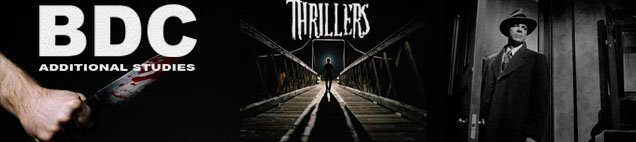
Obviously most actors do not work in only one genre but some are seen more regularly in Thriller films than others. Below I have listed some of the actors who I have seen in Thrillers who have inspired me in some way.
BRUCE WILLIS
Bruce Willis is a fab actor who usually appears in Action films such as the 'Die Hard' movies. The film 'Hostage' could probably fall into several genres, including Action, but it is extremely thrilling. He plays the hero, out to save the day (as always). His "hard man" characters usually show a softer side (in this film his affection for his family makes emotional) that contrasts to his strong exterior. He is great to watch, both in action sequences and still moments where his character is reflecting or hiding.
JULIA ROBERTS
I still haven't seen the entire film but 'Sleeping with the Enemy' is a good example of a Psychological Thriller that really makes you empathise with the female lead, sticking to the thriller genre but really messing with your head along the way. Julia Roberts is a great example of an actress who can act naturalistically and comically, meaning that when you see her play "scared", there is real contrast and it's quite unnerving.
ROBIN WILLIAMS
Again, Robin Williams is a terrific comedy actor. However, in 'One Hour Photo' he does a great job of creating a disturbing, obsessive character. Because he looks like quite a normal man, seeing him play a role like this is particularly disturbing. You almost begin to question other "normal" looking people around you. He draws you in, before scaring you away with his sudden changes in character as the film goes on.
JODIE FOSTER
When I saw 'Flight Plan' at the cinema, I was actually terrified. Jodie Foster is a really interesting, believable actress and because of this, you really empathise with her in this film. Her eyes are really distinctive and alot of her panicked performance is seen there.
Sunday, 22 November 2009

Thriller Directors
To learn more about the Thriller genre and to inspire my own work, I have done some research on Thriller Directors.
ALFRED HITCHCOCK
I am not a huge fan of Thriller films but I had heard of Hitchcock, probably because he is one of the most influencial British film directors of all time- due to the fact he embraced new technologies and changed the world of cinema with both the new found "talkies" and with his unique directing style.
He grew up with very strict parents (which is reflected in some of his films). He studied engineering and worked for a while as an advertising designer for a cable company but he soon became interested in the technology of photography. This intrigue led him to go for a job at what was to become Paramount Pictures in London. He started off designing titles for silent movies and, within five years of his career at Paramount, he made his way into directing.
To begin with, his films were under-financed and flopped but eventually he made his break. After several UK successes, Alfred Hitchcock moved to America under a new contract and began directing there. His films (he made in his lifetime) were nominated for several awards, although he never won the academy award for Best Director.
*Key points of Hitchcock's work*
-His 10th film 'Blackmail' (1929) was one of the first films made with sound in the UK
-One of the first directors in America to film on location, as opposed to in studios
-Developed a technique of using famous landmarks as the location for suspence sequences
-Hitchcock's films 'often placed an innocent victim (an average, responsible person) into a strange, life-threatening or terrorizing situation' [http://www.filmsite.org/thrillerfilms.html]
-He used a technique whereby he placed a lightbulb inside a glass of milk, to give it a glowing, supernatural quality. This created a greater contrast between the colours in the scene and manipulated the audience into looking at certain parts of the screen.
-Sometimes he used heightened music, suchas in 'Psycho' where he included a screechy violin
-He created great suspense and anticipation in films like 'Frenzy' by using long camera movements, taking the action from inside a building to outside and to the other side of the street, slowly revealing the whole picture
-Hitchcock was a fan of withholding information from the audience to build tension, sometimes by hiding the identity of characters or making them seem dangerous/vulnerable (depending on the situation). He did this through the use of filming characters in profile or in partial shadow
-'Strangers on a train' included a sequence where you see the murderer in the reflection of the victim's glasses
-He often filmed sequences in confined spaces to build the suspense and heighten the emotion of the scene
-In some of his films, Hitchcock was more experimental, exploring his interest in Expressionism. An example of this is the surrealistic dream sequence in 'Spellbound', in which he used many of the above techniques. http://www.youtube.com/watch?v=dzxlbgPkxHE
I think that there are several elements of Hitchcock's style that I would like to involve in my own work, such as the use of shadows, confined spaces, loud music and revealing things slowly to increase anticipation.
ALFRED HITCHCOCK
I am not a huge fan of Thriller films but I had heard of Hitchcock, probably because he is one of the most influencial British film directors of all time- due to the fact he embraced new technologies and changed the world of cinema with both the new found "talkies" and with his unique directing style.
He grew up with very strict parents (which is reflected in some of his films). He studied engineering and worked for a while as an advertising designer for a cable company but he soon became interested in the technology of photography. This intrigue led him to go for a job at what was to become Paramount Pictures in London. He started off designing titles for silent movies and, within five years of his career at Paramount, he made his way into directing.
To begin with, his films were under-financed and flopped but eventually he made his break. After several UK successes, Alfred Hitchcock moved to America under a new contract and began directing there. His films (he made in his lifetime) were nominated for several awards, although he never won the academy award for Best Director.
*Key points of Hitchcock's work*
-His 10th film 'Blackmail' (1929) was one of the first films made with sound in the UK
-One of the first directors in America to film on location, as opposed to in studios
-Developed a technique of using famous landmarks as the location for suspence sequences
-Hitchcock's films 'often placed an innocent victim (an average, responsible person) into a strange, life-threatening or terrorizing situation' [http://www.filmsite.org/thrillerfilms.html]
-He used a technique whereby he placed a lightbulb inside a glass of milk, to give it a glowing, supernatural quality. This created a greater contrast between the colours in the scene and manipulated the audience into looking at certain parts of the screen.
-Sometimes he used heightened music, suchas in 'Psycho' where he included a screechy violin
-He created great suspense and anticipation in films like 'Frenzy' by using long camera movements, taking the action from inside a building to outside and to the other side of the street, slowly revealing the whole picture
-Hitchcock was a fan of withholding information from the audience to build tension, sometimes by hiding the identity of characters or making them seem dangerous/vulnerable (depending on the situation). He did this through the use of filming characters in profile or in partial shadow
-'Strangers on a train' included a sequence where you see the murderer in the reflection of the victim's glasses
-He often filmed sequences in confined spaces to build the suspense and heighten the emotion of the scene
-In some of his films, Hitchcock was more experimental, exploring his interest in Expressionism. An example of this is the surrealistic dream sequence in 'Spellbound', in which he used many of the above techniques. http://www.youtube.com/watch?v=dzxlbgPkxHE
I think that there are several elements of Hitchcock's style that I would like to involve in my own work, such as the use of shadows, confined spaces, loud music and revealing things slowly to increase anticipation.
Wednesday, 11 November 2009
180 degree rule
The 180 degree rule can be tricky to understand but it is an important rule to remember when filming.
Between the actors is a straight line that divides the scene in half. On one side of the line is the camera and on the other is the background of the scene. In this shot, you would see actor 1 on the left and actor 2 on the right of the screen.
(BACKGROUND OF THE SCENE)
ACTOR 1--------------------------------------ACTOR 2
CAMERA
(somewhere along this line)
If the camera was to cross this line and show the scene from the other side, the actors would appear to be on opposite sides- you would see actor 2 on the left and actor 1 on the right of the screen.
CAMERA
(somewhere along this line)
ACTOR 1------------------------------------ACTOR 2
(BACKGROUND OF THE SCENE)
This would become very confusing as a director and as an audience member because switching from one shot to another would make it look as if the actor had moved places in the scene.
However, as long as you stay on one side of the line throughout a film sequence, you can move within the space. This means that you can move backwards (creating a wider shot) or closer (to film CUs).
Positioning the camera in the middle (as shown above) establishes the entire scene because more of the picture can be seen. The closer that you get to the 180 degree line, 'the more the viewer's point of view resembles the character's' (http://www.solutioneers.net/cinema/axis.htm). This would give the audience a sense of empathy with the character because they are seeing the scene through their eyes.
If done by mistake, breaking the 180 degree rule can confuse and disorientate the viewer. However, some directors make a conscious decision to step over the line. It can be done to disorientate the audience on purpose in a more abstract way (this would not necessarily work in a more naturalistic, linear sequence). Some directors cross the line by filming a shot where the camera moves from one side of the line to the other. As long as this is included, breaking the rule can be effective because we as an audience have seen the camera switch sides, therefore we understand where we are in relation to the scene. This can show us something from another perspective and reveal more of what is taking place. Directors such as Yasujirō Ozu and occasionally Stanley Kubrick sometimes crossed the line and broke the rule, to different effects.
Between the actors is a straight line that divides the scene in half. On one side of the line is the camera and on the other is the background of the scene. In this shot, you would see actor 1 on the left and actor 2 on the right of the screen.
(BACKGROUND OF THE SCENE)
ACTOR 1--------------------------------------ACTOR 2
CAMERA
(somewhere along this line)
If the camera was to cross this line and show the scene from the other side, the actors would appear to be on opposite sides- you would see actor 2 on the left and actor 1 on the right of the screen.
CAMERA
(somewhere along this line)
ACTOR 1------------------------------------ACTOR 2
(BACKGROUND OF THE SCENE)
This would become very confusing as a director and as an audience member because switching from one shot to another would make it look as if the actor had moved places in the scene.
However, as long as you stay on one side of the line throughout a film sequence, you can move within the space. This means that you can move backwards (creating a wider shot) or closer (to film CUs).
Positioning the camera in the middle (as shown above) establishes the entire scene because more of the picture can be seen. The closer that you get to the 180 degree line, 'the more the viewer's point of view resembles the character's' (http://www.solutioneers.net/cinema/axis.htm). This would give the audience a sense of empathy with the character because they are seeing the scene through their eyes.
If done by mistake, breaking the 180 degree rule can confuse and disorientate the viewer. However, some directors make a conscious decision to step over the line. It can be done to disorientate the audience on purpose in a more abstract way (this would not necessarily work in a more naturalistic, linear sequence). Some directors cross the line by filming a shot where the camera moves from one side of the line to the other. As long as this is included, breaking the rule can be effective because we as an audience have seen the camera switch sides, therefore we understand where we are in relation to the scene. This can show us something from another perspective and reveal more of what is taking place. Directors such as Yasujirō Ozu and occasionally Stanley Kubrick sometimes crossed the line and broke the rule, to different effects.
Tuesday, 10 November 2009
Filming Prelim Task (take two)
This time, we all came to the lesson with ideas as to where we could film. Our location was decided quickly which meant that we could focus on filming. Our new setting meant that we had to adapt a couple of our pre-planned shot types (for example, in the corridor there was not enough room for a side-on long shot so we cut this out and filmed a couple of alternative shots to try out in the editing process)
We also found that it was more time effective for us to film some of the shots out of sequence because of where we had the cameras set up. This meant that we had to keep a record of what we had previously filmed to prevent missing any shots out.
Once we got started, we got a few new ideas of how to improve our shot types so we experimented as we worked, making sure we got several takes of each section and sometimes from different camera angles so that we could use the best sequences in editing.
We did make a few minor errors such as moving props and forgetting where they went back. Silly mistakes like this could ruin our film sequence so it is good to make these mistakes sooner rather than later. Also, whilst editing, we noticed that at one point you could see my reflection in the window in the background, filming Jake. This is something we had not thought of whilst filming!
Even though Jake and Samson acted in our piece, we all took turns to set up the camera equipment and we made group decisions about any changes made or if one of us noticed that a shot was not working, we would come to a collective solution to the problem.
We also found that it was more time effective for us to film some of the shots out of sequence because of where we had the cameras set up. This meant that we had to keep a record of what we had previously filmed to prevent missing any shots out.
Once we got started, we got a few new ideas of how to improve our shot types so we experimented as we worked, making sure we got several takes of each section and sometimes from different camera angles so that we could use the best sequences in editing.
We did make a few minor errors such as moving props and forgetting where they went back. Silly mistakes like this could ruin our film sequence so it is good to make these mistakes sooner rather than later. Also, whilst editing, we noticed that at one point you could see my reflection in the window in the background, filming Jake. This is something we had not thought of whilst filming!
Even though Jake and Samson acted in our piece, we all took turns to set up the camera equipment and we made group decisions about any changes made or if one of us noticed that a shot was not working, we would come to a collective solution to the problem.
Filming Prelim Task (take one)
Our first job was to take our cameras and list of shots to find a location to film. We experienced problems to begin with (it was a busy time of day so there were lots of people around who were in the way or making noise, one room would have been ideal but there wasn't very much space for our equipment, corridor areas were much darker than we expected). Eventually, we found a room but after filming a few shots, the room was needed by another class, therefore we had to leave and return to our classroom for the end of lesson.
We were really disappointed that we were unable to complete the task first time round. I now know that when it comes to film our thriller sequences, we must take into consideration a great variety of factors, including things that are out of our control like our working environment. This means we will need to have back up plans in place, just in case we get into a similar situation with our final project (whereby we will not have time to re-schedule and re-film).
We were really disappointed that we were unable to complete the task first time round. I now know that when it comes to film our thriller sequences, we must take into consideration a great variety of factors, including things that are out of our control like our working environment. This means we will need to have back up plans in place, just in case we get into a similar situation with our final project (whereby we will not have time to re-schedule and re-film).
Initial Ideas for Prelim
The plot of our prelim was not overly important so we decided to get this over and done with straight away to allow us to plan the rest of our work. We brainstormed several ideas and finally chose a patient entering the doctor's office.
To add some comedy to our piece we made our patient an overweight male, who finds out he is pregnant. We wanted to show how our character was quite large so we wanted to experiment with the cameras to show this (zooming or a handheld, wobbly effect).
To make the conversation abit more interesting to watch and to show the intensity of the situation, we wanted to use a range of shot types (POV, over-the-shoulder, CUs, two shots...).
We also wanted to find a room that we could adapt to seem like a doctor's room. However, the most important thing about our location was that we kept in mind the 180 degree rule whilst positioning our cameras to film.
Below is our initial list of shot types that we used to begin filming our piece-
*Low angle shot from the floor (Jake steps over the camera, wobble affect)
*Long shot from side-on (show him walking towards the door)
*Ped, to slowly reveal Jake (ending in a close up of him eating)
*Point-of-view shot (him knocking on the door)
*Medium shot (Samson turning, 'come in')
*Close up (of Jake opening the door, hand on handle)
*Over-the-shoulder shot (from Samson, looking at door opening and Jake entering)
*Two shot of the desk (Samson is in shot, Jake walks into frame and sits down)
*Switch between over-the-shoulder shots of both characters (dialogue)
*Close up (Jake's reaction the the news)
*Extreme Close up (Jake's darting eyes)
To add some comedy to our piece we made our patient an overweight male, who finds out he is pregnant. We wanted to show how our character was quite large so we wanted to experiment with the cameras to show this (zooming or a handheld, wobbly effect).
To make the conversation abit more interesting to watch and to show the intensity of the situation, we wanted to use a range of shot types (POV, over-the-shoulder, CUs, two shots...).
We also wanted to find a room that we could adapt to seem like a doctor's room. However, the most important thing about our location was that we kept in mind the 180 degree rule whilst positioning our cameras to film.
Below is our initial list of shot types that we used to begin filming our piece-
*Low angle shot from the floor (Jake steps over the camera, wobble affect)
*Long shot from side-on (show him walking towards the door)
*Ped, to slowly reveal Jake (ending in a close up of him eating)
*Point-of-view shot (him knocking on the door)
*Medium shot (Samson turning, 'come in')
*Close up (of Jake opening the door, hand on handle)
*Over-the-shoulder shot (from Samson, looking at door opening and Jake entering)
*Two shot of the desk (Samson is in shot, Jake walks into frame and sits down)
*Switch between over-the-shoulder shots of both characters (dialogue)
*Close up (Jake's reaction the the news)
*Extreme Close up (Jake's darting eyes)
Introduction to Prelim Task
The brief for our Preliminary Task was that our footage must include:
- match on match action
- shot-reverse-shot
- the 180 degree rule.
Our individual storyline could be anything but we had to include someone opening a door, crossing the room, sitting down opposite the other character and a few lines of dialogue.
Continuity in any film sequence is extremely important because if your shots are not linked smoothly and your lighting/props/scenery etc are not continuous, it can make your work look very amateur and nobody would want to watch it. During this task we will need to ensure we consider the continuous nature of the scene, in practice and preparation for filming and editing our thriller openings.
- match on match action
- shot-reverse-shot
- the 180 degree rule.
Our individual storyline could be anything but we had to include someone opening a door, crossing the room, sitting down opposite the other character and a few lines of dialogue.
Continuity in any film sequence is extremely important because if your shots are not linked smoothly and your lighting/props/scenery etc are not continuous, it can make your work look very amateur and nobody would want to watch it. During this task we will need to ensure we consider the continuous nature of the scene, in practice and preparation for filming and editing our thriller openings.
Subscribe to:
Posts (Atom)


